Why a 150-pound garage door feels like 8 pounds in your hand
By Garage Door Science | Published:
Categories: Garage Door Maintenance
Tags: maintenance, openers, springs, technical
A residential steel garage door weighs between 130 and 350 pounds. An insulated double-wide sits at the upper end of that range. When you lift one by hand and it feels like roughly 8 pounds in your grip, you are not lifting the door. You are lifting the small residual imbalance the counterbalance system has not already cancelled. The full lab on why a 150-pound door feels like 8 pounds covers the complete mechanical treatment. This article covers the architecture, the energy numbers, the failure sequence, and the one diagnostic you can safely perform yourself.
How the counterbalance system cancels door weight
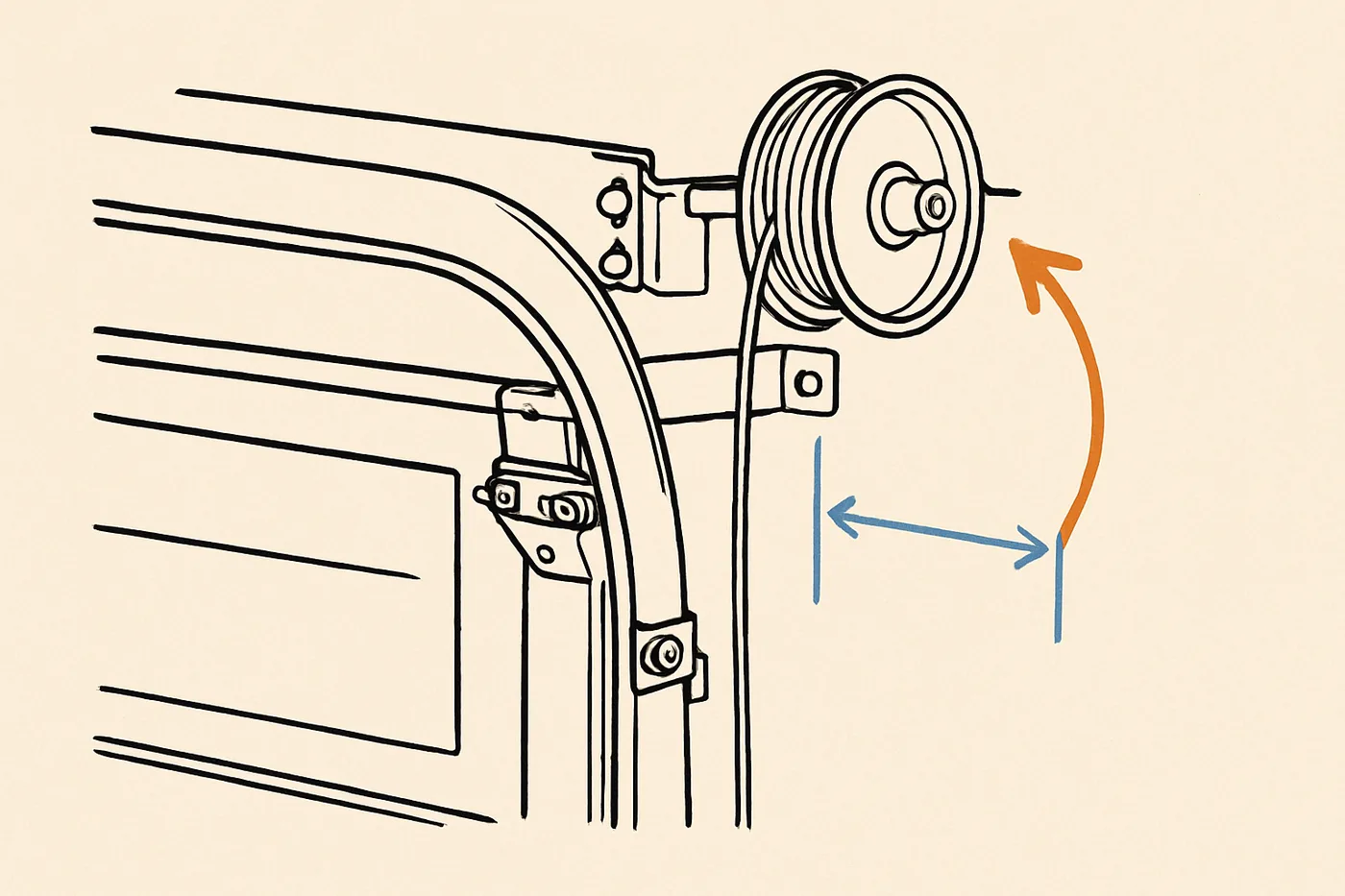
A torsion spring is mounted above the door on a steel shaft. Cables run from that shaft, around drums at each end, down to brackets on the bottom corners of the door. When the door is closed, the spring is wound to a tension that stores energy approximately equal to the gravitational potential energy the door would gain if raised to the fully open position. When the door rises, the spring unwinds and transfers that energy through the shaft, through the drums, through the cables, and into lifting the door. When it descends, gravity rewinds the spring. The system trades potential energy between spring tension and door height on every cycle.
A perfectly balanced door would float at any height with zero applied force. A correctly balanced door drifts an inch or two and stops. The 8-pound residual you feel at the handle is that small margin, intentional by design, so the opener has something to work against.
What the opener actually does
The opener does not lift the door. A 1/2-horsepower motor produces a nominal output measured in foot-pounds at the output shaft. That output is not sufficient to raise a 200-pound door against gravity at any practical speed. The opener works because the spring has already cancelled the load. The trolley on the rail is overcoming friction and a small imbalance margin. Nothing more. For a full treatment of how load stress shortens opener life, see how long a garage door opener should last.
A fatigued spring is an opener-killing failure mode. As spring tension drops across thousands of cycles, the effective door weight at the opener climbs from 8 pounds toward the door’s actual mass. The motor strains. The drive gear wears. Limit switches drift out of calibration. The opener fails not because it aged, but because the spring aged underneath it and nobody caught it in time.
The energy stored in a wound torsion spring
A standard residential torsion spring stores around 236 ft-lb of energy at full wind, the instantaneous energy available to the system when the door is fully closed. Across each cycle, the spring absorbs approximately 800 ft-lb of cumulative torsional stress as it winds and unwinds under load. Those are different measurements of different things: one is the energy the spring holds, the other is the fatigue load it accumulates. Both matter. The stored energy is what makes the system dangerous to work on. The fatigue load is what eventually kills it. Climate compounds the risk: in freeze-thaw zones, cold-soaked high-carbon steel loses measurable ductility, which raises the probability of a sudden brittle fracture rather than a slow fatigue crack. The cold-weather spring failure mechanics are covered in detail here.
That 236 ft-lb does not bleed off slowly. If the cone slips or the spring fractures under tension, it releases all at once, in whatever direction the geometry of the failure points. Those are not approximations pulled from general warnings. Fractured wrists and winding bars driven through drywall are the documented consequences in field failure reports.
Cycle life and what imbalance costs you
A standard residential torsion spring is rated for approximately 10,000 cycles. At two cycles per day, that is 13.7 years on the arithmetic. Real-world conditions, temperature variation, and minor imbalance cut the practical service life closer to seven years. If your household cycles the door more than four times daily, the math shifts enough to make high-cycle oil-tempered springs rated for 25,000 to 100,000 cycles a cost-effective upgrade.
An out-of-balance door does not just shorten the spring’s life. Every component downstream carries load it was not specified for. Motors, cables, rollers, hinges, and bottom brackets all age faster simultaneously. A door that should last 25 years can start failing across multiple subsystems at 15. The spring is the load regulator for the entire assembly, not a standalone wear item. See how long a garage door should last for the full component-by-component service-life breakdown.
The one balance check you can perform safely
There is exactly one diagnostic you can perform on the counterbalance system without specialized tools. Pull the red emergency release cord to disengage the opener. Lift the door by hand to roughly waist height. Let go. A correctly balanced door will hold position or drift only an inch or two before stopping. A door that crashes down is undersprung. A door that snaps upward is oversprung. The balance check guide walks through each failure pattern in detail, including what the test result tells you about how urgently you need a technician.
What you can verify, and where the line is
The balance test above is yours to run. So is a visual inspection of the spring coil, look for gaps between coils, surface rust, or thinning at the center winding zone. You can also listen: grinding, popping, or a noticeable change in how hard the opener is working are all early signals worth tracking.
That is where your diagnostic work ends. You cannot safely perform any adjustment that requires inserting a winding bar into the spring cone. You cannot safely perform any cable work at the drum. You cannot safely work the bottom-corner brackets, which are anchored under the full lifting tension of the system. The 236 ft-lb stored in a wound torsion spring releases all at once. The consequence is not a sprain.
For anything beyond the hand-lift balance check and visual inspection, call a licensed technician who arrives with correct winding bars, the correct spring specification for your measured door weight, and the training to handle the energy state of the assembly. A spring replacement before failure runs $150 to $300 as a scheduled appointment. After a failure, on a morning when you have somewhere to be and the door won’t move, the job costs the same. The difference is whether you chose the timing.
Frequently Asked Questions
Why does my garage door feel so light when I lift it by hand?
A garage door feels like 8 pounds instead of 150 or more because torsion springs store energy equal to the door’s gravitational potential energy and release it as the door rises, cancelling nearly all the load. What you feel at the handle is the small residual imbalance the system intentionally leaves so the opener has something to work against. The spring does the lifting; you are only guiding it.
How do I know if my garage door springs are losing tension?
The hand-lift balance test is the fastest check: disengage the opener with the red release cord, lift the door to waist height, and let go. A properly tensioned door holds position or drifts only an inch or two. A door that crashes down has lost spring tension. A door that snaps upward is oversprung. Either result warrants a call to a licensed technician before the next use.
Can a worn-out torsion spring damage my garage door opener?
Yes. A standard residential opener is designed to nudge a balanced door, not lift a full 150 to 350 pounds against gravity. As spring tension drops over thousands of cycles, the effective load on the opener motor climbs toward the door’s actual weight. The motor strains, the drive gear wears prematurely, and limit switches drift out of calibration. Spring fatigue is one of the most common causes of premature opener failure.
How long do garage door torsion springs last?
A standard residential torsion spring is rated for approximately 10,000 cycles, which works out to roughly seven years of real-world use at two cycles per day, after accounting for temperature variation and minor imbalance loads. High-use households cycling more than four times daily may exhaust a standard spring in three to four years. High-cycle oil-tempered springs rated for 25,000 to 100,000 cycles are available for households above that threshold.
Is it safe to adjust or replace a garage door torsion spring myself?
No. A fully wound residential torsion spring stores approximately 236 ft-lb of energy. If a winding bar slips during adjustment, that energy releases instantly and without warning. The documented consequences include fractured wrists and skull injuries. This is not a task where confidence or mechanical skill changes the risk calculus. A licensed technician arrives with the correct winding bars and the spring specification matched to your door’s measured weight.
Does climate affect how often garage door springs need service?
Yes, in two distinct ways. In freeze-thaw climates, high-carbon spring steel loses ductility in cold temperatures, raising the risk of sudden brittle fracture rather than a gradual fatigue crack. In humid coastal environments, surface corrosion accelerates metal fatigue at the coil surface. Both conditions can shorten a spring’s effective service life below the rated 10,000-cycle figure, making annual visual inspections more important than the cycle arithmetic alone suggests.